P. L. Blake Ltd. Sustainability Report (August 2026)
1. Introduction
This report sets out P. L. Blake Ltd.’s (hereafter PLB) approach to corporate social responsibility (CSR) and environmental sustainability. It presents PLB’s current CSR governance, strategy, and performance, and outlines the goals, targets, and action plans through which the company intends to reduce its environmental impact and strengthen its wider social responsibility over the coming years.
PLB is committed to operating as a responsible business and to embedding sustainability and CSR considerations across every aspect of its operations, from day-to-day practices through to long-term strategic planning. This commitment extends across its economic, legal, ethical, philanthropic, and environmental responsibilities, as set out in Section 4.
Unless otherwise stated, the data and activities discussed in this report relate to the 2024 calendar year.
This report is structured as follows. Section 2 outlines the scope and reporting boundary of the data presented, including the business activities covered and any exclusions. Section 3 describes PLB’s CSR governance, including its Sustainability Committee. Section 4 sets out PLB’s CSR strategy across five pillars of responsibility. Section 5 details the goals, targets, and action plans established in 2025 and 2026, including PLB’s GHG Reduction Action Plan. Section 6 looks ahead to PLB’s future commitments, and Section 7 confirms the report’s approval and ownership. Supporting appendices, figures, and references are provided in Section 8.
For clarity, this report uses the following terms:
- PLB – P. L. Blake Ltd.
- GHG – Greenhouse gas
2. Scope and reporting boundary
This section defines the organisational and operational boundaries of this report and the data it includes, specifically regarding carbon emissions. This report covers PLB only. No subsidiaries or other entities are included. All data is from the 2024 calendar year unless otherwise stated.
The Carbon Estimator report, completed via EcoVadis in July 2025, forms the foundation of much of the dataset and covers the breadth of PLB’s main business activities, such as:
- Office operations
- Warehouse operations
- Company vehicle use (primarily for installations & maintenance)
- Business travel (such as for meetings or quality control checks)
- Upstream activities (purchased goods & services)
- Downstream activities (products sold by PLB)
PLB acknowledges that the reporting is not completely comprehensive, noting the exclusion of:
- Stationary combustion emissions (from boilers, radiators, etc.)
- Scope 2 emissions (market-based & location-based data)
- Employee commuting
- Energy use of PLB products post-installation
- Full quantification of end-of-life treatment
These limitations should be considered when interpreting emissions data.
Figure 1: Table demonstrating the relevance and status of key GHG emissions variables
| Scope | Item | Relevance | Status |
|---|---|---|---|
| 1 | Mobile combustion | Relevant | Reviewed |
| Stationary combustion | Relevant | Outstanding | |
| 2 | Purchased energy | Relevant | Outstanding |
| 3 | Upstream: fuel & energy-related activities | Relevant | Reviewed |
| Upstream: purchased goods & services | Relevant | Reviewed | |
| Upstream: business travel | Relevant | Reviewed | |
| Upstream: waste generation | Relevant | Partial | |
| Upstream: capital goods | Relevant | Outstanding | |
| Upstream: employee commuting | Relevant | Outstanding | |
| Downstream: transport & distribution | Relevant | Reviewed | |
| Downstream: end-of-life treatment | Relevant | Partial | |
| Downstream: leased assets | Relevant | Partial | |
| Downstream: use of sold products | Relevant | Partial | |
| Downstream: franchises | Not applicable | Exempt | |
| Downstream: investments | Not applicable | Exempt |
This report will continue to reference Scope 1–3 emissions throughout. As defined by the Greenhouse Gas Protocol, a 3-scope system was developed to help identify the influence of direct and indirect emissions.
Figure 2: Visual summary of the 3 GHG scopes, as per Greenhouse Gas Protocol standards
3. CSR governance
PLB’s Sustainability Committee, established in August 2024, has been formed with the purpose of implementing CSR strategies, tracking progress towards them, and reviewing their success. Within the committee there are standard members, and a central taskforce who coordinate the team. The committee meets quarterly to share updates on actions taken to achieve the goals outlined in Section 5. With members of the committee spanning a breadth of business functions, goals and targets are owned by a representative of the relevant department.
PLB’s CSR Committee
- Sam Addison – Chief Delivery Officer *
- Lisa Arnold – Strategy Director
- Katie Baker – Managing Director *
- Emily Calton – Operations Coordinator *
- Emily Hung – 3D Designer
- Clifford Irving – Production Manager
- Daniel Irving – Production Prototyping
- Kate Kilmartin – Client Growth Director
- Ash Martin – Field and Stock Operations Assistant
- Ali Raza – Finance Assistant
- Mel Thomas – Senior Account Manager *
* Denotes a member of the central taskforce coordinating the Sustainability Committee.
4. CSR strategy
In line with Carroll’s CSR framework, PLB’s CSR policy is categorised into 4 pillars with the addition of a 5th specifically for environmental responsibilities in recognition of small businesses in the UK collectively accounting for around half of the nation’s GHG emissions. This encompasses activities and behaviours that are required, expected, and desired by society – all of which are equally important to PLB.
Figure 3: Visual demonstrating the key principles of Carroll’s Pyramid of Social Responsibility, adapted to include the environment as a key responsibility
4.1. Economic responsibility
Economic responsibility is the foundation of all business principles. It is a business’ ultimate goal and necessity to create long-term value that supports both the current and future operations. This requires the responsible management of resources, decisions, and performance. A strong financial position allows businesses to meet employee, supplier, client, and all other shareholder expectations, whether that be paying for goods and services or investing in new developments. Once this position is established, businesses not only benefit from long-term economic stability, but they are also then able to enhance their commitment to latter-stage responsibilities like ethics and the environment.
PLB’s economic strategy focuses on strengthening financial resilience by:
- Increasing proportion of revenue from recurring contracts
- Improving operational efficiencies (especially in the field)
- Building a stronger relationship with creditors and debtors alike
4.2. Legal responsibility
All companies have a responsibility to act compliantly with any laws and regulations where they operate. These responsibilities span a range of business practices, however some of the most common ones pertain to:
- Employment & labour
- Health & safety
- Data protection & privacy
- Tax & financial reporting
- Consumer rights & product safety
- Environmental protection
All businesses are expected to uphold appropriate processes and controls to ensure legal and regulatory requirements are adhered to at all times. They should also have measures in place to ensure all relevant parties are informed of them. As with economic responsibilities, legal compliance provides an important baseline for CSR activities. Legal groundings often also spark conversations of ethical responsibilities so the two are closely related. PLB takes its legal responsibilities seriously by ensuring all licenses and certificates are up to date, processes are reviewed frequently, and training is in place to ensure all parties are up-to-date with appropriate and expected practices.
4.3. Ethical responsibility
Whilst ethics are something that are not a legal requirement to consider, it is something that responsible businesses should take accountability for nonetheless. Many companies aim to hold themselves to a high standard of integrity and fairness across the scope of their operations:
- Fair treatment to employees
- Genuine relationships with suppliers and clients
- Responsible supply chain management
- Data privacy
- Environmental stewardship
- Transparency
Moreover, ethical responsibilities form an important influence on stakeholder perceptions of a business so it is important to ensure that suppliers, clients, and the local community alike can all put their trust in said company. For PLB, ethics is a mindset just as much as it is a strategy as the company appreciates that ethical practices allow for more meaningful ones too. The current ethics agenda spans across this aforementioned scope:
- Increase to wages in line with living wage recommendations
- Extended parental leave policy
- Prioritisation of in-person supplier & client engagement to build rapport
- Enhanced supplier audit process
- Plans to develop environmental policy as capacity allows
4.4. Philanthropic responsibility
Stakeholders like staff, suppliers, and clients are important to all businesses, but philanthropic responsibility recognises the role of a company within the wider community. Philanthropy is often regarded as the final responsibility of businesses as it is more about creating a positive social value than bolstering the company’s practices themselves. This is often associated with financial transactions such as charitable donations, however there are many more actions that can be taken that still support social wellbeing. PLB endeavours to honour its philanthropic responsibility through a rotating monthly calendar of events led by staff members, allowing the company to support a range of causes within its community.
4.5. Environmental responsibility
Environmental responsibility is the final main CSR responsibility for businesses to consider. Whilst not identified by Carroll, it is hinted at throughout the CSR pyramid he produced through the legal, ethical, and philanthropic pathways. Just as a company can have a positive, or negative, influence on the local community – it can also have an impact on the environment.
A key way to address environmental responsibility is to consciously take steps to reduce GHG emissions – this may include actions like increasing the share of renewables used in the company’s energy matrix and reducing waste going to landfill. Particular emphasis is given to Scope 3 emissions as these arise from activities outside the company’s direct control but that could still be mitigated, such as:
- Business travel
- Energy efficiency of goods
- End-of-life & disposal
By taking steps to integrate environmental responsibility into its wider CSR policy, PLB intends to make measurable progress towards reducing its environmental impact.
5. Goals, targets, and action plans
5.1. Goals & targets set in 2025
PLB’s Sustainability Committee issued its first Environmental Charter in 2025, a predecessor to this year’s CSR report. Within the charter, it was stated that PLB’s sustainability agenda would focus on reducing cumulative greenhouse gas emissions through 4 key goals:
- Reduce the emissions related to transport and logistics
- Progress towards becoming paperless
- Increase the volume of materials being recycled
- Continue to support the local community
To achieve those goals, 5 more specific targets were set:
- Reduce emission intensity from 897 tCO2e per £1m revenue to 850 tCO2e by 2028
- Incorporate at least 1 hybrid van into the PLB fleet by the end of 2025, to reduce the emissions related to installation, maintenance, and logistics jobs by 5%
- Achieve 50% paperless compliance by 2025 as a first step towards becoming paperless in the field by 2030
- Review the success of the new bin system, implemented in May 2025, to continue to improve the recycling facilities at PLB. This is with the intention of increasing the volume of materials recycled by 15% by 2028
- Hold at least 3 charitable events per annum to support the local community and environment, such as resources bug hotel workshop or conducting litter picks
PLB acknowledges that without a more up-to-date carbon report completed, it is currently difficult to quantify the success of these targets, however steps have been implemented to support with the company’s progress towards their goals. For example, 1 hybrid van has been introduced, 2 different models of digital tablet have been bought to trial paperless compliances, and a charitable event is held almost every month. PLB intends to complete its next carbon report before the end of 2026, at which point the Sustainability Committee would be able to review the success of these initiatives with more rigour. The committee does note, however, that at only 1 year into implementing a CSR strategy at all, the fact that PLB has taken a number of steps towards achieving these targets is a positive first step.
5.2. Targets set in 2026
In lieu of this year’s carbon data, the targets set in 2026 consider 2024’s carbon data in tandem with the current business climate with the ultimate goal of becoming a more responsible company. With recognition of how important GHG emissions are on any business’ CSR landscape, the Sustainability Committee has opted to pivot towards a GHG Reduction Action Plan, and 2 other CSR targets instead of the goals and targets model implemented last year.
5.2.1. GHG Reduction Action Plan
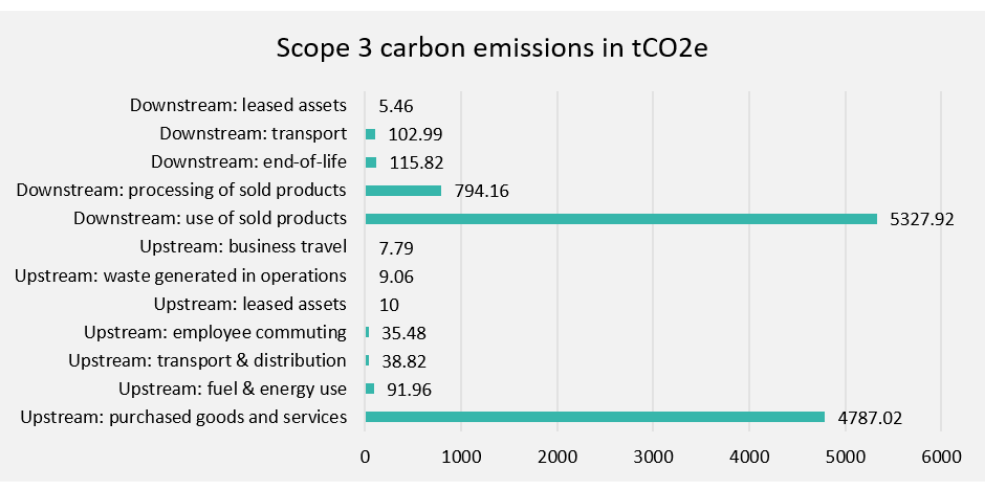
With recognition that approximately 97% of PLB’s emissions pertain to Scope 3 activity, PLB’s action plan serves to formalise the company’s Scope 3 commitment. At this time, without having a 2nd year of carbon data available, the plan is based around UK Business Climate Hub recommendations of a 4.5% improvement each year. As such:
PLB pledges its commitment to reduce absolute Scope 3 GHG emissions by 4.5% by the end of 2026, compared to the baseline level of 11,326.51 tCO2e from 2024.
Figure 4: Table summarising the GHG reduction target
| Element | Details |
|---|---|
| Baseline year | 2024 |
| Baseline Scope 3 emissions (tCO2e) | 11,326.51 |
| Reduction target | 4.5% |
| Target year | 2026 |
| Target emissions | 10,816.82 |
| Coverage | Corporate-level Scope 3 |
| Scope 3 categories | Purchased goods, Fuel, Transport, Commuting, Leased assets, Waste, Business travel, Product use post-installation, Processing of sold goods, End-of-life |
With 12 categories identified, PLB’s Sustainability Committee determined a more focused approach is needed to allow the business to succeed in targeting emissions. With this in mind, 3 specific targets have been set with the intention of reducing GHG emissions as a business:
- Improve energy efficiency of PLB-produced appliances to reduce emissions relating to use of sold products by 10% by the end of 2026.
- Aim to have 90% of uplifted fixtures recycled, reused, or scrapped for parts by the end of 2026 to reduce end-of-life emissions by 50%.
- Cross-skill engineers to support with more efficient routing, to reduce fuel-related emissions from installation & maintenance activities by 10% by the end of 2026.
Based on the emissions data identified in the 2024 carbon report, these targets were selected as they are both achievable and more influential on PLB’s GHG landscape than existing targets like recycling and paper usage. Target 1 relates to use of sold products, the single biggest contributor towards PLB’s Scope 3 emissions in 2024. Targets 2 & 3 pertain to end-of-life and fuel, the 4th & 6th most significant respectively too.
Figure 5: Graph depicting PLB’s 2024 Scope 3 carbon emissions by category, as per EcoVadis’ Carbon Estimator report